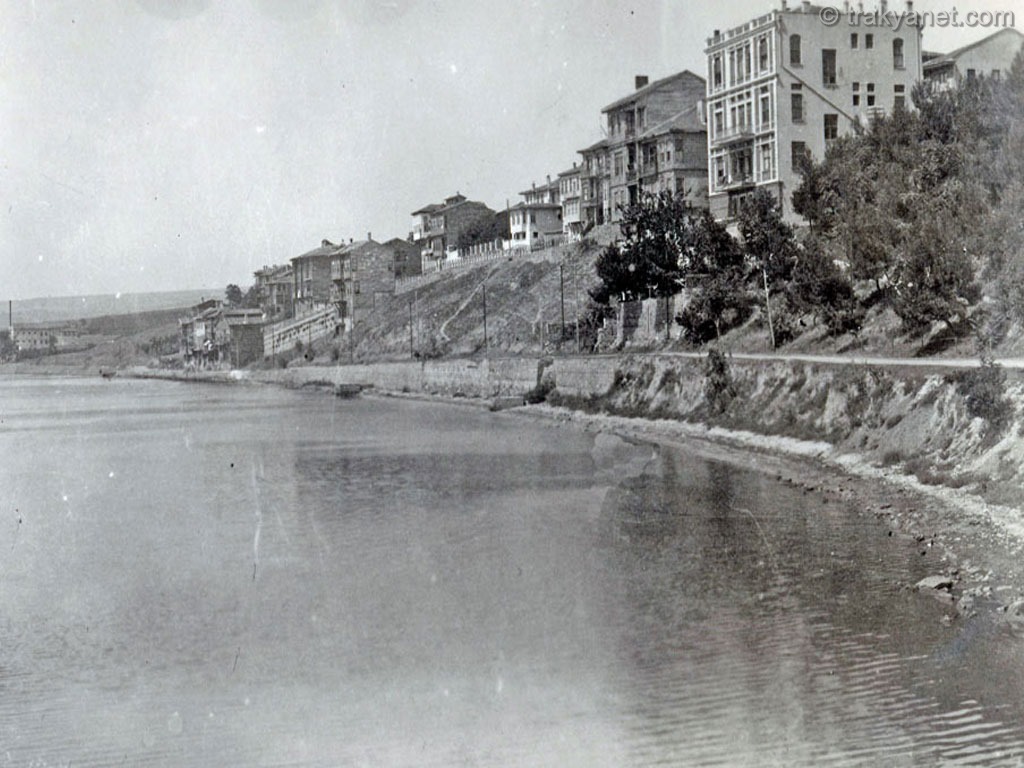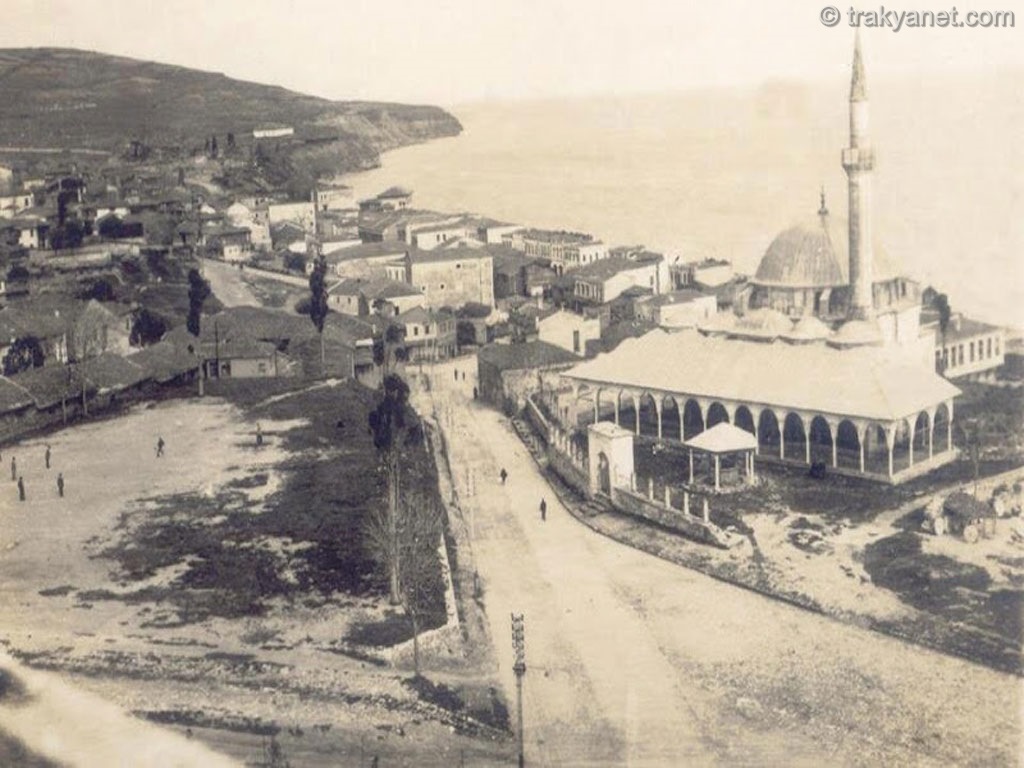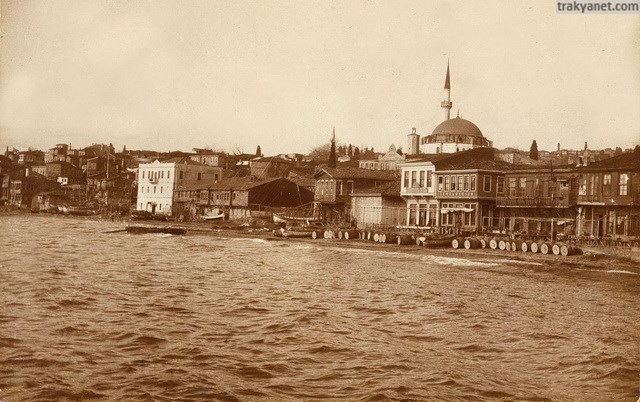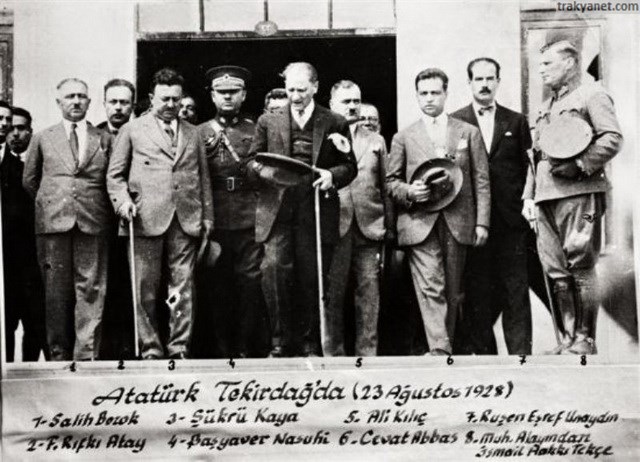

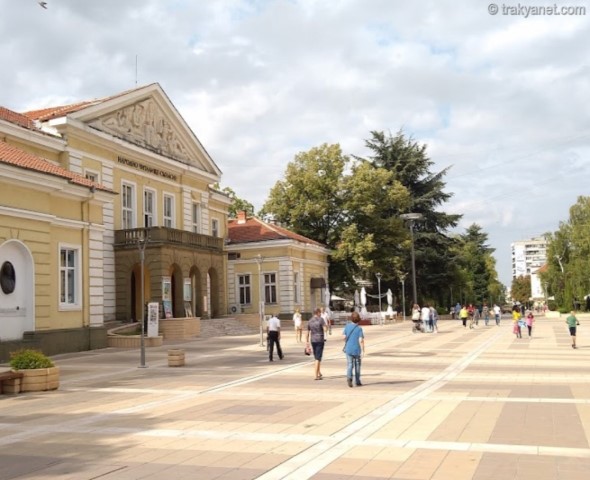
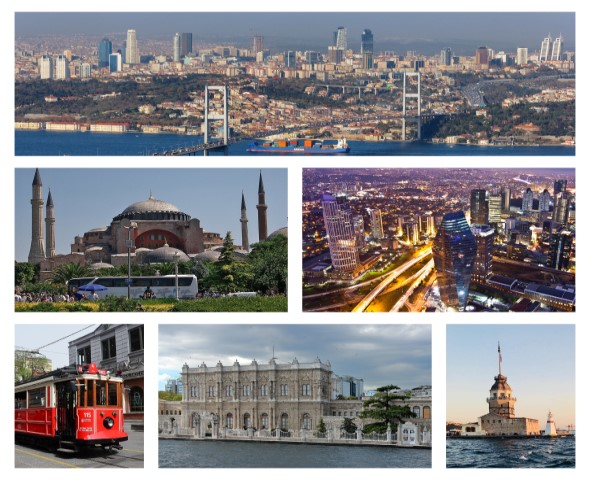
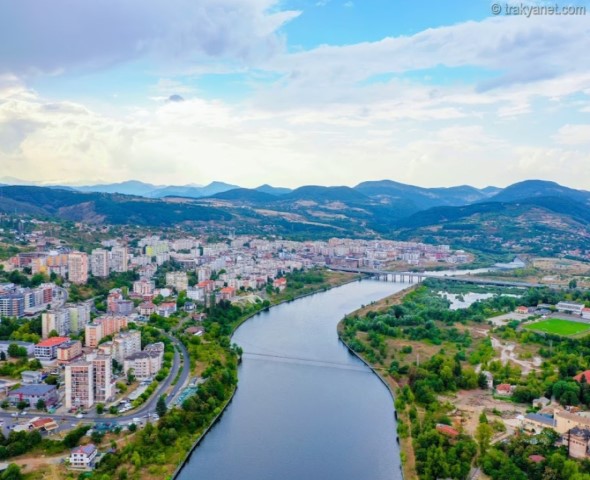
Tekirdag has been home to statesmen who left a deep mark on Turkish history from the Ottoman period to the present day, as well as important historical leaders exiled from Europe. Furthermore, the city is the birthplace of many valuable figures who shaped the world of literature and art during the Republican era.
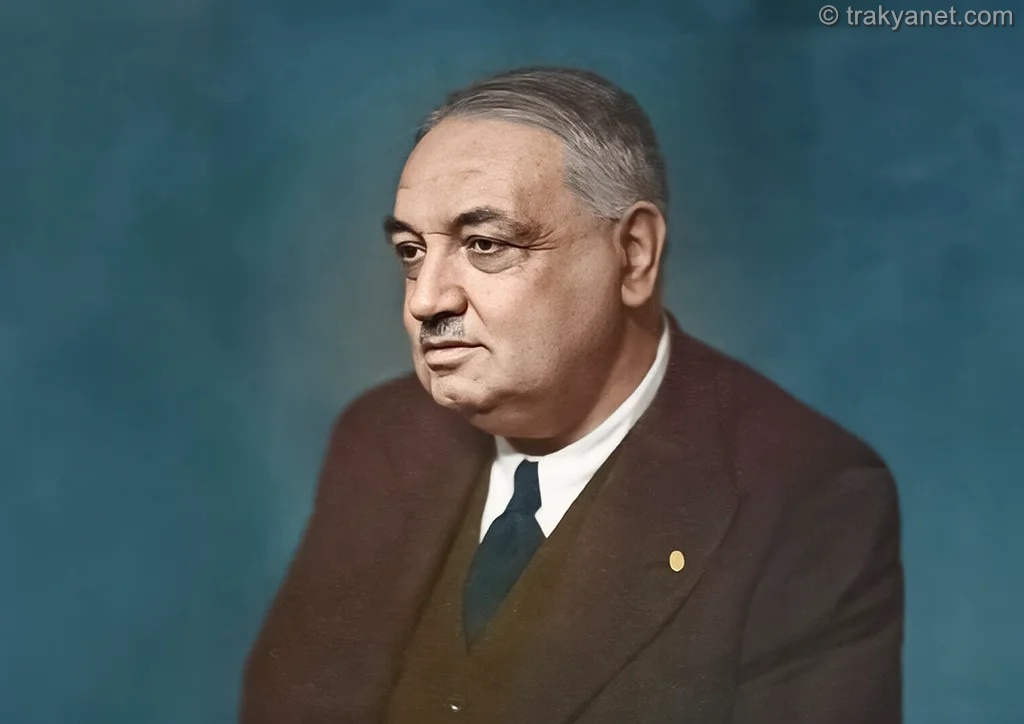
Yahya Kemal Beyatli
When we say "Tekirdag, the Land of Three Kemals," one of them is the great poet Yahya Kemal Beyatli, who was born in the Balkans (Skopje). He served as a Member of Parliament for Tekirdag during the Ataturk era, in the 5th term on March 1, 1935, and in the 6th term on April 3, 1939. He expressed his attachment and interest in Tekirdag in his poetry with the words "Tekirdag, the Horizon of Conquests." Therefore, referring to Tekirdag as "Tekirdag, the Land of Three Kemals" should not be considered wrong or meaningless.
He was born in Skopje on December 2, 1884. His real name was Ahmed Agâh. He completed his primary education at Vefa High School in Istanbul. After going to Paris (1903) and improving his French at a college for a year, he entered the Faculty of Political Science. After returning from Paris, where he stayed for nine years (1912), he taught various courses at the university in Istanbul (1915-1923).
He became a Member of Parliament for Urfa (1923); he was appointed to the embassies in Warsaw (1926) and Madrid (1929), and served as a Member of Parliament for Tekirdag (1935-1942) and Istanbul (1943-1946).
He went to Pakistan as an ambassador (1948), retired a year later and returned home (1949). He is buried in the Rumelihisari cemetery. A monument was erected in his honor in the park near the Sports and Exhibition Palace (1968). He found his personality in the taste for history he acquired from the lectures of the famous historian Albert Sorel while studying in Paris, and in the beauty of meter and form in the works of French poets (Jean Moreas, Baudelaire, Verlaine, etc.).
Although his trip to Paris was an escape from the oppression of Abdul Hamid II, he cultivated himself in artistic circles without participating in political activities. He thus freed himself from the influence of Hamid and Servet-i Funun poetry before his time in Paris, and approached classical Ottoman poetry with the same holistic understanding found in Western poetry. Upon his return from Europe, he became known for the ghazals and songs he published in Yeni Mecmua under the title "Found Pages" (1918). These neoclassical poems demonstrate that his starting point was Ottoman history and poetry, and even in his later works written in new forms and with a simpler language, it is evident that the poet generally remained committed to Ottoman civilization and culture.
In his work, history, homeland, nation, and love for Istanbul are always explored from this perspective. Since Ottoman civilization created its most sublime works in Istanbul for centuries, Yahya Kemal's admiration for Istanbul, the Bosphorus, and Turkish music is intertwined with historical values, alongside natural beauty. The poet, who skillfully blends emotion, thought, and imagination, draws the themes of his lyrical-epic poems, many of which have a narrative character, from love, nature, the sea, death, and eternity. His emphasis on internal harmony above all else, his acceptance of poetry as "a kind of music different from other music," led him to write all his poems, except for the poem "Ok," in the Aruz meter, which he considered more suitable for achieving this harmony. Yahya Kemal did not collect his poems, articles, and stories in books during his lifetime; his works remained scattered in magazines.
After his death, a Society of Lovers of Yahya Kemal was founded by his friends and admirers, and a Yahya Kemal Institute and Museum was opened under the auspices of the Istanbul Conquest Society (1961). In the Yahya Kemal Complete Works that this Institute began to publish, the poet's first three volumes contained his poems; Other works that compiled his articles, essays, and memoirs include: Our Own Celestial Dome (1961), With the Wind of Old Poetry (1962), Rubaiyat and Turkish Renditions of Khayyam's Rubaiyat (1963), Beloved Istanbul (1964), Bend Down Mountains (1966), Political Stories (1968), Political and Literary Portraits (1968), On Literature (1971), My Childhood, My Youth, My Political and Literary Memories (1973), Historical Conversations (1975), Unfinished Poems (1976), Letters-Articles (1977). The number of books published about him exceeds twenty.
Ferenc Rakoczi II
Ferenc Rakoczi II and his entourage, who were forced to leave Hungary, lived as refugees, and thus became a symbol of refugee status in the eyes of the Hungarian people in the preceding centuries, lived in Tekirdag between 1720 and 1735.
Ferenc Rákóczi II (Borsi, March 27, 1676 – April 8, 1735, Tekirdag) was a leader of the Hungarian independence movement. He served as Prince of Transylvania from 1704 to 1711.
Ferenc Rákóczi belonged to one of the noble Hungarian families of Transylvania; his father, Ferenc Rákóczi I, served as Prince of Transylvania from 1652 to 1659.
In 1700, Rákóczi secured French support for a potential Hungarian war of independence against the Habsburg dynasty. However, Austrian intelligence services became aware of this, leading to his arrest and imprisonment. When his death sentence became certain, he escaped from prison and fled to Poland. In 1703, the withdrawal of a large part of the Austrian army from Hungary due to the War of Spanish Succession created an opportunity for a Hungarian war of independence. Ferenc Rákóczi returned to Hungary with Polish and French support. Following the war of independence that began in 1703, Rákóczi assumed the title of Prince of Transylvania as Ferenc Rákóczi II.
In 1705, he was proclaimed Prince of Hungary by the assembly of nobles assembled in the city of Szecheny. The defeat of Hungarian independence fighters against Austrian forces in the Battle of Trencin in 1708 led the pro-independence forces to attempt to reach an agreement with the emperor. In this context, peace negotiations began in 1711, but Rákóczi left Hungary for Poland as a precaution. In Rákóczi's absence, the Peace of Szatmar was signed between the rebels and Austrian representatives (1711), ending the war of independence initiated under Rákóczi's leadership. However, the Peace of Szatmar, which officially ended the war, was never acknowledged by Prince Ferenc Rákóczi II until the end of his life.
The prince first sought refuge in Poland, then in France. Later, in the autumn of 1717, at the invitation of Sultan Ahmed III, he traveled to Ottoman territory with a small entourage. In 1720, the Ottoman Sultan designated Tekirdag, a city on the coast of the Marmara Sea with a functioning port, as the settlement for the Hungarian refugees. Sultan Ahmed III allocated buildings in the outskirts of the city, surrounded by extensive gardens along the coast, for the "Hungarian King's" use, and twenty-three large and functional buildings in the adjacent Armenian quarter for his entourage. Seven large pastures were also set aside for horses. To ensure the continued operation of Ferenc Rákóczi II's principality and to cover its expenses, a permanent income was also secured from Istanbul. The Sultan sent interpreters and scribes to facilitate operations, and a Janissary unit of eighty men was provided to ensure their security.
From Tekirdag, the prince engaged in a widespread and lively exchange of letters with the kings of France, Spain, Russia, and Poland. As a result, he was closely and constantly monitored by the Habsburg government. Despite these activities, history, in relation to the prince's life as a refugee, has given more importance to Ferenc Rákóczi II's writings, his theoretical works on the structure of the state, and his religious writings, rather than his political endeavors. A series of important works, such as "Thoughts," "Memoirs," "Confessions," and "Thoughts on the Structure of Power," were born from this fruitful refugee workshop in Tekirdag. In this intellectual environment, which can be considered very fertile for the literary world, works such as "Letters from Turkey" by Kelemen Mikes, written in beautiful Hungarian by the prince's secretary and describing the lives of refugees, also emerged.
These houses, once inhabited by the Hungarian colony, had fallen into considerable disrepair and ruin by the end of the 19th century. In 1906, the ashes of the Prince and his fellow refugees were ceremonially brought to Hungary and reburied there in a newly arranged funeral. The well-preserved interior wooden decorations of the Rakoczi mansion were taken to the city of Kassa (now Kosice in Slovakia). Efforts have also been made to unearth and collect the personal belongings of the Hungarian exiles in Tekirdag.
The building known as the Prince's dining hall has also served as the Rakoczi Memorial Museum since 1968. This mansion was restored by the Hungarian Republic in 2007. Since February 2010, an exhibition system showcasing the Transylvanian Prince and his family, the war of independence, and the lives of refugees, prepared in several languages, has been open to visitors in this building.
Sons of Turhan
The Turhan family was present alongside Suleyman Pasha in the conquest of Rumelia, initially settling in the vicinity of Malkara, and rendered glorious services to our nation throughout the founding period. The most famous individuals from this family are, in order, Pasa Yigit, Turhan Bey, and Omer Bey. It is understood that this family, at the head of the Saruhanli nomads, crossed into Rumelia.
Pasha Yigit
He was a famous raider commander who crossed into Rumelia with Suleyman Pasha. During the reigns of Murad I and Bayezid I, he served as the vanguard commander of the Skopje Beylik and the First Battle of Kosovo. His tomb is located in Pasa Yigit or Pasakoy, a place known for its lignite mines between Kesan and Uzunkopru.
Mr. Turhan
He was the son of Pasha Yigit Bey. He was one of the most prominent commanders of the reigns of Murad II and Mehmed the Conqueror. His tomb is located in the village of Kirkkavak, north of Malkara, in the Edirne province. Turhan Bey had a complex built there. During the reign of Murad II, he secured the state's safety in Greece, the Peloponnese, and Albania through his brilliant campaigns in these regions. Turhan Bey is remembered in our history as the conqueror of the Peloponnese in 1446 and as the commander who dealt a heavy blow to the Hungarians in the Second Battle of Kosovo.
Turhan's son, Omer Bey
He was the eldest and most renowned son of Turhan Bey. His tomb is next to the mosque in Malkara. In 1458, he participated in the recapture of Morea alongside Mehmed the Conqueror. He earned the admiration of a great sultan like Mehmed for capturing Athens at that time. Mehmed said of him, "How can religion and state not be grateful to the son of Turhan for the conquest of such a place?" In 1462, he fought against Vlad the Impaler in Wallachia. He showed great bravery in the conquest of Bosnia. He led one of the most glorious raids in Turkish history on the city of Venice. In the Battle of Otlukbeli in 1473, due to the mistake of his vanguard commander Murat Pasha, Uzun Hasan Bey was captured. Even so, he always praised Mehmed the Conqueror in front of Uzun Hasan. Uzun Hasan Bey admired Omer Bey's bravery and loyalty and refrained from killing him. After his release from captivity, he participated as a vanguard commander in the conquest of Albania. During the reign of Bayezid II, he participated in the wars against the Mamluks of Egypt in Cukurova, where he again displayed significant heroism and rendered valuable services.
Ayas Pasha
Ayas Pasha rendered significant services in the conquest of Egypt and captured Tomanbay. He participated in all of Suleiman the Magnificent's campaigns and eventually became his Grand Vizier. The victory at Preveza was won during his time as Grand Vizier. Ayas Pasha, who died of the plague in 1539, owned extensive lands and forests around Vize-Saray. He had a complex built in Saray, including a mosque, school, madrasa, imaret (soup kitchen), and bathhouse. He endowed this complex with his aforementioned properties. Today, only the mosque and bathhouse remain of the complex. Ayas Pasha frequently visited Saray from Istanbul. Later, the courtyard of the Ayas Pasha Mosque became the cemetery of the Crimean Khans and Girays.
Rustem Pasha
Rustem Pasha, son-in-law and Grand Vizier of Suleiman the Magnificent, had a beautiful complex built in Tekirdag, including a mosque, bathhouse, madrasa, imaret (soup kitchen), cells, and library, as well as a six-domed covered market supported by two elephant-foot pillars (1552). The architect of these structures, of which only the mosque, covered market, and bazaar remain standing, was Koca Sinan. Rustem Pasha also had a caravanserai in Buyukkaristiran and a bathhouse in Hayrabolu, but these have been destroyed. During his lifetime, he donated many cellars, tanneries, and shops in Tekirdag, as well as properties in Malkara and Hayrabolu and their surrounding villages. Now, the most valuable historical and architectural works in Tekirdag are the aforementioned mosque and covered market.
Poet Ahmedi Sarban
He lived during the reign of Suleiman the Magnificent and participated in the Iraq campaign. He died in 1545 in Hayrabolu, where he lived and settled as the commander of the camel corps. He rose to the rank of spiritual leader of the Melamiye-i Bayramiye order. For this reason, he is known by the people as Sarban Baba and is revered at his tomb. He also used the name (Kaygusuz) in his poems. An unpublished divan (collection of poems) exists in the Uskudar Selim Aga Library, in the Hasim Pasa register, number 87.
Nev'i, the poet from Malkara
He was born in Malkara in 1533. He was a scholar, teacher, and poet. He tutored princes in the palace. His poems are mostly Sufi in nature and are as beautiful as those of his friend Baki. He has a divan (collection of poems) and also unpublished scholarly books. He was the son of the famous poet, scholar, and judge Atayi (Ataullah) Nev'i, who was also known for his poems and valuable works.
Grand Vizier Bekri Mustafa Pasha of Tekirdag
He rose through the ranks of the Janissaries. In 1679, he became the Agha of the Janissaries. After the execution of Kara Mustafa Pasha of Merzifon, he briefly served as commander-in-chief, but was unsuccessful. After serving as Governor of Kanije, Commander of Seddulbahir, and again as Agha of the Janissaries, he became Grand Vizier in 1688. However, due to his fondness for entertainment and incompetence, he was dismissed before completing two years in office and sent to Malkara, where he died two months later. 1690
Admiral Gazi Hasan Pasha from Tekirdag
Although he is known as Gazi Hasan Pasha of Algeria, he was originally from Tekirdag. The great and meticulous historian Cevdet Pasha, along with Mustafa Pasha and Enveri, authors of Netayic-ul Vukuat, all state that he was from Tekirdag. Hasan Pasha was born in Tekirdag in 1715. He was very mischievous as a child. As a young man, he joined the army and participated in the wars against Austria, displaying great bravery. During this period, representatives of the Western garrisons in Istanbul would sail along the Marmara coast in their own ships, recruiting daring and adventurous soldiers to engage in piracy. Upon returning from the Austrian war, Hasan went to Algeria on such a ship. He quickly rose to prominence, demonstrating his formidable character even on the voyage. He intimidated the Arabs and increased his enemies.
Faced with this situation, he came to Turkiye during the reign of Mustafa III and became a captain. This is why he was called Hasan of Algeria. Hasan Bey of Algeria first gained great fame in the naval battle of Cesme against the Russians. Later, he liberated the islands of Lemnos and Lesbos from the Russians.
He secured the Dardanelles Strait. Following his victories and successes, he became the Grand Vizier and Admiral of the Fleet. He suppressed the rebellions of Tahir Omer in Syria, the Albanians in Morea, and the Mamluks in Egypt. He rendered significant services as Admiral of the Fleet, Commander-in-Chief, and Grand Vizier in the 1788 Ottoman-Russian War. He was such a formidable vizier (his position was one of supreme authority and inspired fear and anxiety in everyone). The historian Vasif said of him: "That formidable Vizier comes, his sword bloody in one hand; beware, O heart, of this path, for it is a formidable development." He was seventy years old when he became Grand Vizier, but his strength remained intact. He took the administration of the state under his strong grip and embarked on substantial undertakings. In the decree sent to him by Sultan Selim III, he said, "I have given you complete satisfaction. I have entrusted and assigned to your faithful hand all the affairs of the state, both partial and complete."
Hasan Pasha prepared an alliance with Prussia in 1790 against our enemies, the Russians and Austrians. Just as he was about to sign this alliance, he contracted a fever and died on March 23, 1789. Gazi Hasan Pasha is the greatest figure from Tekirdag after Namik Kemal.
He was the Barbarossa Hayrettin of his time. He established the Naval Engineering School in collaboration with Baron de Tot. He had barracks built for the naval soldiers. He was a righteous, brave, fearless, and powerful statesman. He had a passion for lions and horses. He would let his lions roam freely and sleep beside him. He could climb and descend forty or fifty steps on horseback.