
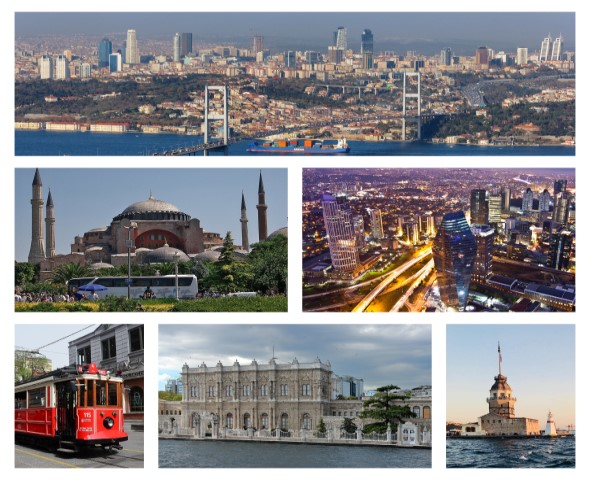
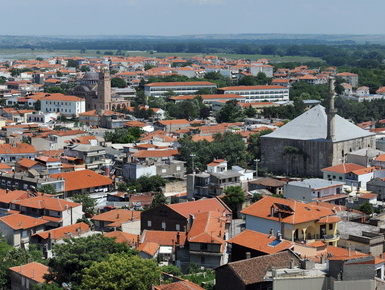
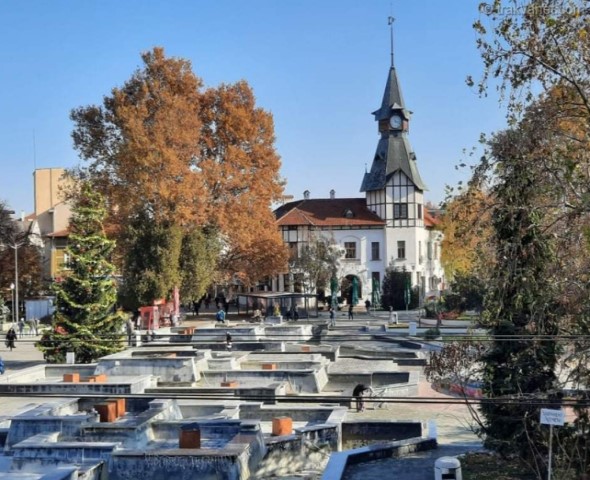
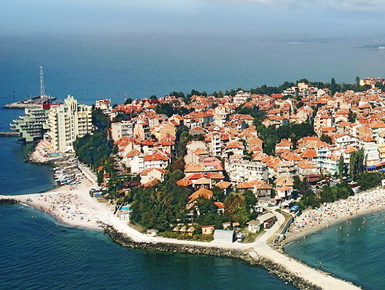
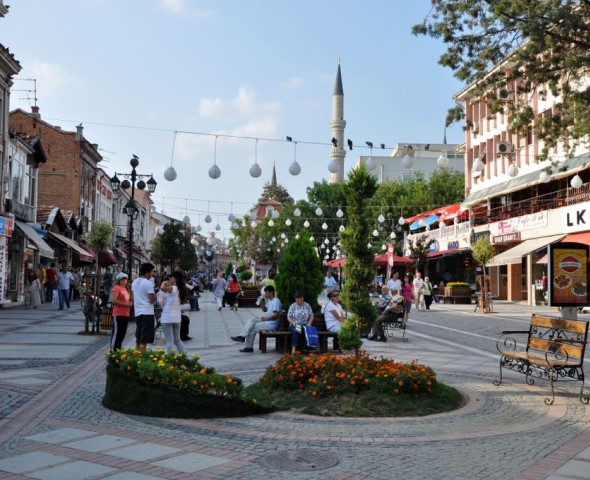
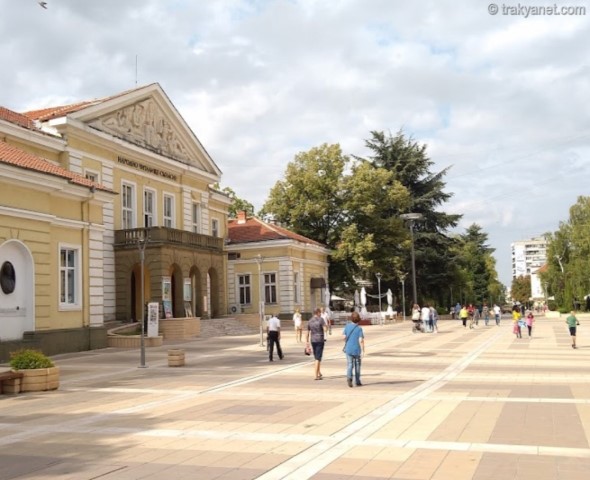
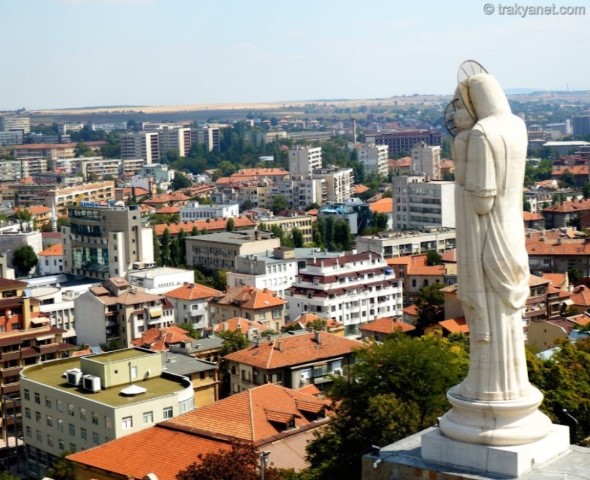
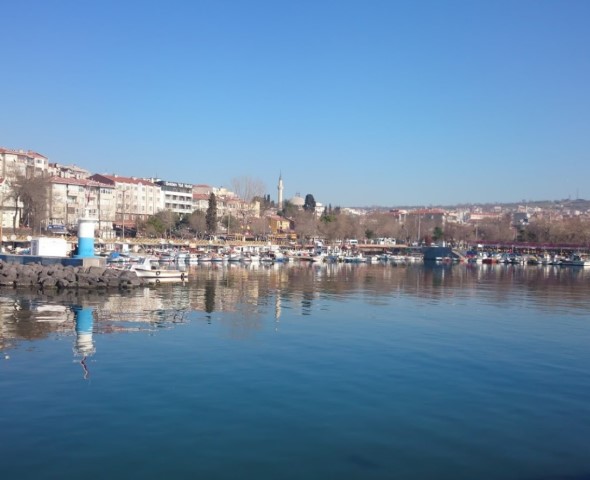
Tekirdag is known as the "Land of the Three Kemals" because of the great leader Mustafa Kemal Ataturk, the poet Yahya Kemal Beyatli, and the national poet Namik Kemal, who hold a special significance for the city.
The great national poet Namik Kemal was born in Tekirdag on Monday, December 21, 1840 (Monday, Shawwal, 1256 AH). His father was the chief astrologer Mustafa Asim Bey, and his mother was Fatma Zehra Hanim. His grandfather, Abdullâtif Bey, the tax collector (deputy governor in charge of financial affairs) of Tekirdag (Tekfurdag), and his maternal grandmother, Mahmude Hanim, lived in a two-story house with a large garden and a pink-painted basement, located on Hukumet Street in the Camii Vasat (Orta Cami) neighborhood of Tekirdag.
Hafiz Ali Riza Efendi from Tokat, who named his son Muhammed Kemal (Mehmet Kemal), was the sheikh of the Persembe Tekkesi near the building. Arif Efendi from Tekirdag, one of the poets of the time, commemorated him by writing the line: "Honor came to this world with Muhammed Kemal."
Four years later, when his grandfather Abdullâtif Bey was transferred to Tirhala, Kemal and his family moved to a wooden mansion on the same street, where the old municipal building's garden used to be. After the mansion was demolished, a monument was erected in the corner of the garden by Mehmet Seref (Aykut), a member of parliament from the Committee of Union and Progress.
Mehmet Kemal, who stayed in this mansion for two years, moved to Afyon with his family when his grandfather was appointed governor of the Afyonkarahisar province.
Namik Kemal, who arrived in Istanbul in 1857, befriended poets adhering to the Divan tradition (Leskofcali Galip, Yenisehirli Avni, etc.). In 1863, he joined the Translation Office, where he met Sinasi. He improved his French and, influenced by Sinasi, turned to learning Western literature. He began writing for Tasvir-i Efkar. When Sinasi went to Paris in 1865, he took over the management of the newspaper. He joined the Young Ottomans Society. The newspaper was shut down due to his writings on the Eastern Question. In 1867, he fled to Paris with Ziya Pasa. From there, he went to London. In 1868, he launched the Hurriyet newspaper. Two years later, he returned to Istanbul. He founded the Ibret newspaper with three friends. The newspaper was shut down for four months due to his article titled "Garaz Maraz" (Malice and Illness). Namik Kemal was appointed governor of Gelibolu. Upon his return, he resumed publication. The play "Vatan Yahut Silistre" (Homeland or Silistre), which was being performed at that time, was received with enthusiasm by the public. Following an article about it published in the newspaper "Ibret," the government issued a warning. A response was given in the next issue of the newspaper. As a result, Namik Kemal was exiled to Cyprus in 1873.
He spent 38 months imprisoned in Famagusta Castle. He wrote many of his works there. When Abdulaziz was deposed in 1876, he was released. Upon arriving in Istanbul, he was appointed to a position in the Council of State. He worked in the Constitutional Committee. He was arrested because of a report submitted to Abdulhamid and remained in prison for five and a half months. Although he was acquitted, he could not escape. In 1877, he was exiled to the island of Mytilene. Then, in 1879, he was appointed governor there. Later, in 1884, he was appointed governor of Rhodes and in 1887, governor of Chios. He died in Chios on December 2, 1888. His grave is in Bolayir, Gallipoli.
The Ancestry of Mehmet Namik Kemal
His paternal lineage includes: Bekir Aga from Konya, Topal Osman Pasha (martyred in a battle against the Persian ruler Nadir Shah during the reign of Sultan Mahmud I), Ratip Ahmet Pasha (Admiral of the Navy), Semsettin Bey (Chief Chamberlain of Sultan Selim III), and Mustafa Asim Bey (a scholar of history and astrology). Mustafa Asim Bey is his father.
Maternal Lineage: On his mother's side, his grandfather, Abdullâtif Bey, was born in Konice, which is now outside our borders. His maternal grandmother was Mahmude Hanim, and his mother was Zehra Hanim.
Days Spent in Afyon
Mehmet Kemal received lessons in Arabic and Persian from Haci Velid Efendi of Bukhara, the mufti of Afyon. He learned the customs of the Sufi order from Coskun Dede, the head ney player of the Afyon Mevlevi Lodge. He lost his mother, Fatma Zehra Hanim, on 1st Shawwal 1264 (August 31, 1848). His mother was buried in the garden of the Afyon Mevlevi Lodge. Her sarcophagus was destroyed in a fire in 1291 (1895). The tombstone that still exists bears the inscription: "The inscriptions begin with 'Abdullâtif Efendi's beautiful daughter...' and continue with 'May Zehra Hanim find her place in Paradise, in the beautiful eternal life of 1264.' Abdullâtif Efendi, who was transferred from the Afyon tax office to Kutahya, came to Istanbul with his family after his duty ended and settled in his house on Zeyrek Fil Yokusu. Kemal first attended Bayezid secondary school and then Valide school (Dar'ul Maarif). His teacher was Sakir Efendi. At home, Kemal learned Arabic and Persian privately from his father."
Meanwhile, his grandfather was appointed as the governor of Cyprus, and from there, with the rank of Mir-i Miran, meaning Beylerbeyi, he was appointed to the Lazistan province. His rank was elevated to that of Pasha.
Namik Kemal in Kars
When his grandfather was appointed governor of Kars, Kemal also went to Kars. During the year and a half he spent in Kars, he learned the science of saving and classical Ottoman literature from the elderly sheikh, poet, and teacher Vaizzade Seyid Mehmet Hamid Efendi. He had the opportunity to study the philosophy of Unity of Being, as well as Miḥid-i Arabi and Mevlana. He took lessons in hunting, archery, and javelin throwing from a rural commander named Kara Veli Aga. The years around 1854 were a time when the Ottoman Empire was fighting on many fronts. The battles of Oltanice, Citane, Silistre, and the Crimean War followed one another. He was thrilled by the shelling of Sevastopol. He rejoiced at the news of victories from Balikova, Elmali, and Gozleve. After his assignment in Kars ended, he returned to Istanbul with his grandfather. He inherited his sense of history and love of books from his father, Mustafa Asim Bey.
Ten months later, he moved to Sofia because his father was the Treasury Manager in Plovdiv, Bulgaria, and his grandfather was the Governor of Sofia. After reading the poems Kemal had written, the poet Major Esref Bey, who was a guest in their home, created a pen name and gave him the name Namik. From then on, he became known as Namik Kemal.
Marriage
In 1856, at the age of 16, he married Nesibe Hanim, the 14-year-old daughter of Mustafa Ragip Efendi, the judge of Niš, who was renowned for her beauty. From this marriage, they had two daughters, Feride and Ulviye, and a son, Ali Ekrem.
First Public Service Position
Having learned some French in Sofia, Kemal began his first job as an intern in 1857 after his family returned to Istanbul. His workplace was the translation office of the Sublime Porte. In 1858, Kemal lost his grandmother, Mahmude Hanim, and in 1859, his grandfather, Abdullâtif Pasha. Meanwhile, his father, who had married Durriye Hanim, moved to his new home in Koca Mustafa Pasha.
We see Namik Kemal later in the Customs House, in the translation office, in the Society of Poets, in the Tasvir-i Efkâr newspaper published by Sinasi, in the Young Ottomans Society, in the Deputy Governorship of Erzurum (a position he never held), in Paris, and in London. Wherever he went, Namik Kemal wrote letters to his family and friends and articles for newspapers, using literature as a means to achieve his political and national ideals, defending the idea that the nation and its people should live under a regime of freedom.
"It is better to die than to live without freedom." Civilization and progress were the words he used most frequently. Advocating for banking and private enterprise, Kemal wanted a constitutional government established in Turkiye and administrative and social reforms implemented. After arriving in Istanbul via Vienna, Kemal became the Governor of Gallipoli after publishing the Ibret newspaper (September 26, 1872).
A three-story house, which burned down in 1914, was allocated to the Governor of Gallipoli. Namik Kemal wrote his Gallipoli Letters in this mansion. He visited the tomb of Gazi Suleyman Pasha, the conqueror of Rumelia, in Bolayir. He bequeathed to Ebuzziya Tevfik Bey that he be buried there.
Namik Kemal, who stayed in Gallipoli for about five months, resolved the water issue in Gallipoli and addressed some other problems. Using an incident in the Jewish Cemetery as a pretext, he was transferred to Istanbul. He began working on plays. On April 9, 1873, he was sent to Cyprus by Sultan Abdulaziz. He completed some of his works there. He returned to Istanbul on April 19, 1876.
Namik Kemal is back in Istanbul.
We see that Namik Kemal was subsequently included in the Constitutional Assembly as a member of the Council of State on September 18, 1876. Namik Kemal, who served in the Military Gifts Association and aid societies for soldiers and their families fighting in Serbia and Montenegro, was tried in court as a result of a report given to Sultan Abdulhamid regarding an article he published.
Having been acquitted in the case, Kemal was sent to the island of Mytilene with a monthly allowance of 50 gold liras from the Imperial Treasury.
Namik Kemal's Days in Mytilene
From Mytilene, he wrote letters to his friends, showing them the path the Ottoman state should take. Letters he wrote to his son-in-law, Rifat Bey, were published. By order of Sultan Abdul Hamid II, he became the Governor of Mytilene two and a half years later. From December 18, 1879, as a result of his tenure, he prevented smuggling by foreigners, increased treasury revenue, opened 20 Turkish primary schools in Mytilene, and improved the living standards of the Turkish population. He prepared a report outlining the problems of the Turkish population living on the islands and submitted it to the Sublime Porte.
In Mytilene, Kemal's efforts to protect the interests of foreign fishermen and prevent smuggling displeased the Italians. Local Greeks, along with local notables and smugglers whose interests were harmed, collected signatures and complained about Kemal. After spending 7 years and 4 months in Mytilene, Kemal became the Governor of Rhodes on October 15, 1884. Having received the Bâlâ rank medal from Sultan Abdul Hamid, Kemal was again honored with the Sultan's medal of distinction in Rhodes.
Kemal, who valued education and learning, opened Turkish primary and secondary schools on the island of Rhodes, and wrote some of his works there, which he later published in Istanbul.
After three successful years in Rhodes, he became the Governor of Chios.
Chios Island and His Death
Namik Kemal began his duties in Chios in December 1887. He fell ill on the island, which had a dry climate. He was treated by his friend Dr. Ornstein, a good physician of Greek origin. Shortly before his death, he wrote this poem in a signed photograph given to his son Ali Ekrem: "
Isn't honor and wisdom enough reward?
Although the path to success is closed for Kemal,
even if you don't see much white in his beard,
thank God his face is pure, his forehead clear."
Namik Kemal, who died on Sunday afternoon, December 2, 1888, was initially buried in the cemetery of a mosque on Chios Island. However, following an appeal to the palace by his friend Ebuzziya Tevfik Bey, the grave was opened, and the lead-stained coffin was transported from Chios to Gallipoli on the ship Eser-i Nuzhet. He was ceremonially reburied in Gallipoli next to the tomb of Gazi Suleyman Pasha, the Conqueror of Rumelia, in Bolayir. The design of Namik Kemal's tomb was drawn by the poet Tevfik Fikret, and the expenses for the domed tomb were paid by Sultan Abdulhamid.
Because the columns were damaged in the 1912 earthquake, he is currently buried in a marble-covered tomb. The tombstone bears the following couplet by the deceased, along with a Fatiha prayer:
"If I die without seeing the prosperity I hoped for in the nation,
let it be written on my tombstone: 'The homeland is sorrowful, and I am sorrowful.'"
Namik Kemal's Physical Appearance
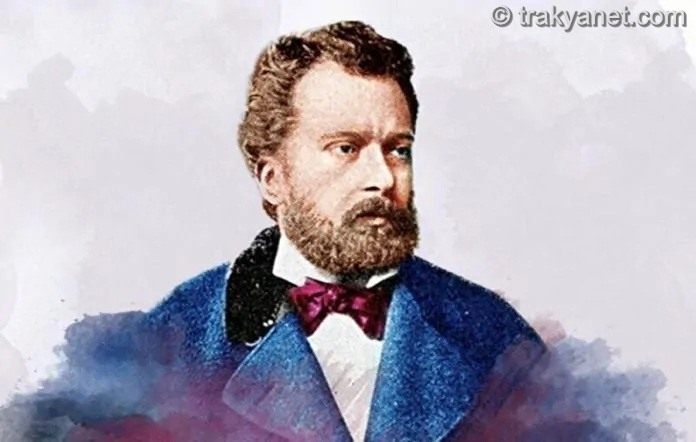
According to his son Ali Ekrem Bey, Namik Kemal was a man of medium height, somewhat stout, with a large head, a high forehead, a rosy complexion, a large nose, a beautiful mouth, a long brown beard that darkened after the age of forty, broad shoulders, and small hands and feet. He rarely got angry, but when he did, the anger lasted a long time and he would bleed from his nose. He didn't like adornments at all. He dressed very simply, ate little, and slept little. Although his voice was somewhat hoarse due to chronic bronchitis, he had a deep voice.
His Ideas, Art, Writings, and Poems
Namik Kemal was the first thinker to introduce the words "Homeland," "Nation," "Freedom," and "Independence" into our intellectual life and literature, expressing them as a system.
He was a conscious patriot. When he spoke of the "Ottoman nation" or simply "nation," he was thinking only of "Turks." The chaotic state of the empire did not always allow him to explicitly use the word "Turk." When discussing national causes, he used "Turk" instead of "Ottoman," thus clearly revealing for which nation he worked and to which nation he took pride in belonging.
Namik Kemal's greatest service was incorporating patriotism, nationalistic sentiment, and the love of freedom into his poetry.
Namik Kemal was the first Turkish writer to express his personal opinions on a subject. He wrote for various newspapers and magazines such as Mir'at, Tasvir-i Efkâr, Muhbir, Basiret, Diyojen, Ibret, Hadika, Ittihat, Sadakat, Vakit, Muharrir, and Mecmua-i Ebuzziya. He was the owner and writer for Tasvir-i Efkar, Hurriyet, and Ibret newspapers.
In the first issue of the Hurriyet newspaper, published in London in 1868, it stated:
"HURRIYET (Young Ottomans) HUBB-UL-VATAN MIN-EL IMAN (Love of homeland is part of faith).
Everyone's homeland is the dwelling place of the society to which they belong. Should it not be the object of their love more than anything else in the world?
The homeland is that benevolent and generous dynasty from which those who come to its court arrive hungry, helpless, and naked; they are nourished thanks to it, clothed thanks to it, and benefit from its life and freedom thanks to it… Is it fitting that one should not hold their homeland dearer than their own body?
And should the Ottomans not strive to fulfill this sacred duty more than anyone else, for the divine blessing called the homeland is the right of their swords?
If the bones of our ancestors who were martyred in this cause were unearthed from the earth, they would form countless pyramids in every plain of the land and would protect our freedom from enemy attacks." Fortifications can be built.
Let us look at history with a sense of awe. WHAT A GREAT STATE WE WERE. WHAT A MAGNIFICENT
NATION WE WERE…. Aren't the Turks that nation? In their madrasas, Farabis, Ibn Sinas, Ghazalis, and Zamakhsharis emerged and proved their skills and knowledge…. A country that has gained worldwide prestige is amazed, as if it has seen miracles, by looking at the simplest forms of education…”
In the article about the homeland, it is stated:
"Just as infants love their cradles, children love the places where they play, young people love the places where they earn their living, the elderly love their comfortable corners where they withdraw from everything, children love their mothers, and fathers love their families, so too does a person love their homeland with similar feelings." ...
These feelings do not stem solely from an inexplicable natural inclination. A person loves their homeland because our gaze, the most brilliant gift of nature, is directed towards the soil of our homeland from the moment our eyes first open.
A person loves their homeland because the very substance of their body is a part of their homeland.
A person loves their homeland because their freedom, comfort, rights, and interests are all thanks to their homeland.
A person loves their homeland because among the children of the homeland there is unity of language and interest, a closeness of heart, and a brotherhood of ideas.
Namik Kemal wanted to save the crumbling empire. According to him, all those living under the Ottoman (Turkish) flag constitute a single nation. Differences in race, language, and religion are not obstacles to uniting under one state. People living in the same country, with equal rights and shared interests, form a nation.
As for his economic views:
Tax fairness must be ensured, customs freedom and capitulations must be abolished. Economic development can only be achieved through hard work and increased production. Education must be prioritized to ensure comprehensive development. Women should be educated and trained to enter the workforce. We must have a national economic policy, a class of local merchants and industrialists should be formed, local banks should be established, and new schools should be opened to train young people equipped with the latest technology. The 1838 agreements that hindered Ottoman trade and industry should be annulled. In his articles, he pointed to the increasing debts of the late 1850s, stating that this borrowing would ultimately lead to the loss of our political independence.
The Tanzimat reformers were criticized for taking on more debt when they became unable to pay their existing debts.
Namik Kemal focused on industry and trade, the country's natural sources of income. According to him, agriculture, industry, and trade are the three sources of national wealth. A large portion of the population engages in agriculture and trade using outdated technology. The technology of our industry is obsolete. Due to internal rebellions threatening life and property in the empire, very few young people remain to engage in agriculture. Peasants, facing increasingly heavy taxes and economic hardship, are forced to abandon their lands in search of new sources of livelihood.
Long-term, low-interest loans must be provided to rescue our farmers from the clutches of loan sharks. Local trade has been crippled, small businesses have disappeared, shops have closed, and stall and shop owners have begun to turn to the government for help.
Namik Kemal, who used literature as a vehicle for his political and national ideas, advocated for the nation to live under a regime of freedom. Civilization and progress were the words he used most frequently.
Kemal, who championed banking and private enterprise, wanted a constitutional government to be established in Turkiye and social reforms to be implemented, and he promoted this idea in the newspapers he worked for.
While serving as Governor of Lesbos, he wrote to Sultan Abdul Hamid: "
There are only a few primary and secondary schools in Lesbos. The schools are dilapidated, and there is a shortage of teachers. Buildings belonging to Turkish foundations are unusable. Primary schools should be opened in every village of Lesbos, teachers should be sent to these schools, military school training should be provided in secondary schools, boarding classes should be opened, and a maritime school should be established to train sea captains.
To revive olive cultivation, farmers should be protected and freed from usurers, bank branches should be opened, and the tax on olives should be reduced. Customs tax procedures are hindering trade. The judicial and internal organizations should be reviewed and restructured.
Taxes collected in Lesbos should be spent there, and smuggling should be prevented.
There are few schools and mosques on Rhodes. The people have not progressed intellectually and have not received religious education. Schools have been opened in two places, but there is neither a school nor a mosque in the third village. Rhodes needs to be strengthened politically and culturally to prevent its loss."
Namik Kemal and the Turkish Language
According to Namik Kemal, being Turkish is not enough to be a Turkish poet. It is also essential to have written in Turkish. There is Turkish literature, not Ottoman literature, in contrast to Greek, Arabic, and Persian literature. Nationality means culture, and stating that we neglected our national culture, art, and language for a long period of our history, he explains his thoughts on this matter as follows:
"Language and culture are the two greatest forces that strengthen national unity. All foreign words that have not been Turkified by entering the vernacular must be completely eliminated from our language. Spoken and written language should be structured according to the structure of our national language, Turkish, and the influence of Persian languages and literature on our literature and language must be rapidly removed."
Namik Kemal also addressed the issue of the alphabet, stating that the letters we used in those years were Arabic, whereas we are Turks and we should have our own alphabet.
Namik Kemal and Mustafa Kemal
Namik Kemal's works and ideas had the greatest influence on one of the most prominent figures, above all others, Mustafa Kemal Ataturk, the founder of our Republic.
Mustafa Kemal's acquaintance with Namik Kemal and adoption of his ideas came about through his close friend Omer Naci while he was a student at the Manastir Military High School. In a book that Omer Naci gave Mustafa Kemal to read, there are these lines from a poem signed by Namik Kemal: "
The essence of your body is the soil of your homeland.
What sorrow is
there if you become dust on the path of your homeland due to suffering and hardship?" (The dough of your body is from the soil of your homeland; therefore, what is there to grieve if you become dust on the path of your homeland due to suffering and hardship?) "
The enemy has plunged its dagger into the heart of the homeland; there is
no one to save its ill-fated motherland."
To the patriotic poet who lamented, "(The enemy has plunged its dagger into the heart of the homeland; but there is no one to save this ill-fated motherland)," Gazi Mustafa Kemal Pasha, speaking at the Kirsehir Youth Association on December 24, 1919, and later from the podium of the Grand National Assembly of Turkey on January 13, 1921, responded with these lines: "
Let the enemy plunge its dagger into the heart of the homeland
; there will be someone to save its ill-fated motherland."
Another work that influenced Ataturk is Namik Kemal's play "Vatan yahut Silistre" (Homeland or Silistre) and the lyrics of the song in the play. The lines,
"The mark of the wound is on the bodies
of the soldiers, Death is the soldier's final rank…" are reflected in the words he said to Mustafa Kemal:
"NAMIK KEMAL IS THE FATHER OF MY FEELINGS." (Ataturk expressed this thought as follows: "The father of my body is Ali Riza Efendi, the father of my feelings is Namik Kemal, and the father of my ideas is Ziya Gokalp.")
His words clearly show that the concepts Ataturk valued—Homeland, Nation, Freedom, Civilization, Family, Law—were ideas that Namik Kemal had once championed.
Works of Namik Kemal
The collection includes Divan, Intibah, Serguzesti Ali Bey, Cezmi, Vatan Yahut Silistre, Zavalli Cocuk, Akif Bey, Gulnihal, Celâleddin Harzemsah, Kara Belâ, Evrak-i Perisan, Tercume-i Hâl-i Emir Nevruz, Bârika-i Zafer, Devr-i Istila, Kanije, Silistre Muhasarasi, Islam Tarihi, Osmanli Tarihi Mukaddimesi, Osmanli tarihi (three volumes), Tahrib-i Harabat, Takip, Irfan Pasa’ya Mektup, Mukaddeme-i Celâl, Ernest Ronan’a cevap, Cumle-i Muntahabe-i Kemal, Muntahabat-i Tasvir-i Efkâr, Ahmet Mithat’a Mektup, Bahar-i Danis, Ruya, Hurriyet, Ibret, Tasvir-i Efkâr, and other newspaper collections.
Places in Tekirdag named after Namik Kemal
- Namik Kemal Association
- Namik Kemal House
- Namik Kemal Park
- The Namik Kemal statue was created by sculptor Ali Hadi Bora in 1949 and erected by the Tekirdag Municipality.
- Namik Kemal Anatolian High School
- Namik Kemal Primary School
- Namik Kemal Statue in the Coastal Park
- Namik Kemal Regional Theatre is under the auspices of Tekirdag Municipality.
- Namik Kemal Street
- The Namik Kemal monument was erected in 1908 by Mehmet Seref Aykut, the Member of Parliament for Edirne (Tekfurdag).
- Namik Kemal First Public Library
- Namik Kemal University
- Namik Kemal Stadium
- Namik Kemal Tax Office
- Namik Kemal Forest is located on the Tekirdag-Muratli road.
- Namik Kemal Viaduct is located on the Edirne-Istanbul ring road.
- Namik Kemal Regional Theatre